
debugging my career path: between snack walls & startup sprints
the Big Tech mirage, startup frenzy, and what it’s really like to work in both worlds
Corporate Big Tech Mentality
Bloomberg is the perfect place to absorb the mentality (and amenities) that big tech has to offer: becoming inevitably fluent in Agile, daily stand-up and weekly product-sprint meetings, Jira tickets, Gantt charts, and Miro boards. Open floor-plan desk layouts with dual monitors, fancy work pods, reservable conference rooms, and tall glass windows. I’d be remiss if I didn’t mention the main pull factor: the food.
I vividly recollect my first day as a Bloomberg intern, my eyes widening as I took in the bustling 6th-floor "Pantry": a jumbotron flashing news at lightning speed, snacks lined up in regimented rows, and modern furniture dispersed around the open floor's periphery. All the snacks you could possibly imagine at all times: chips, cookies, coffee, fruit, granola bars, crudité. If you arrive before 9am, you might even be lucky enough to get locally sourced bagels, and once a week, they have food samples from a local business. The Park Ave office even has a snack wall.
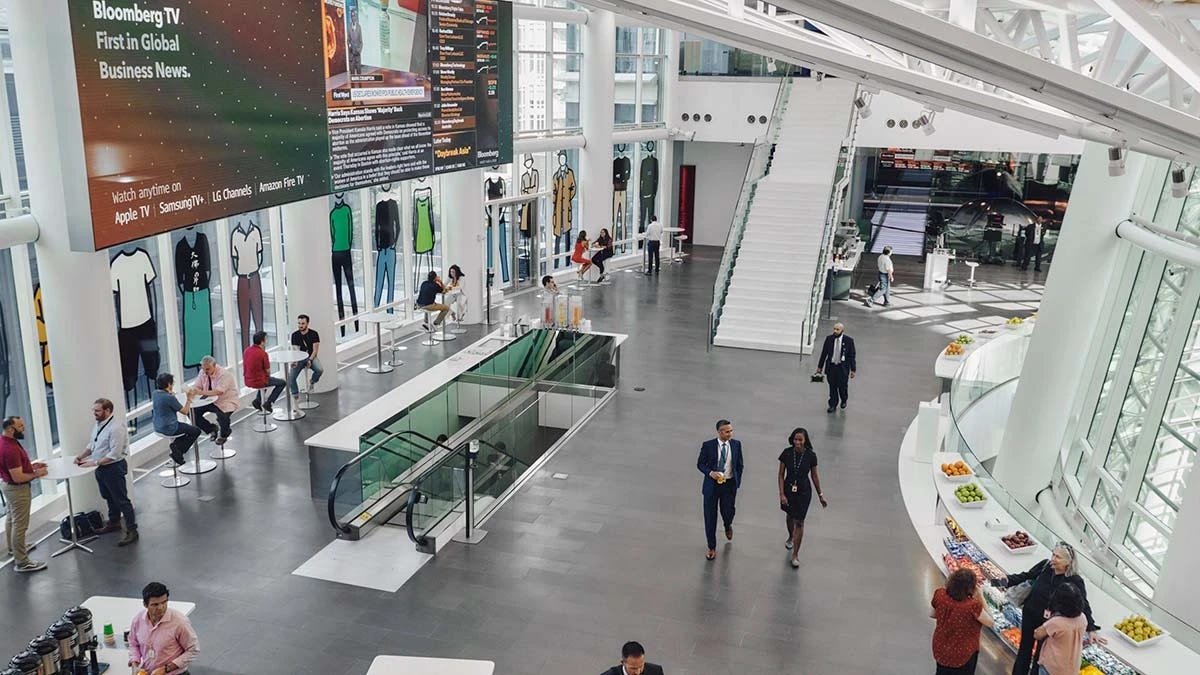
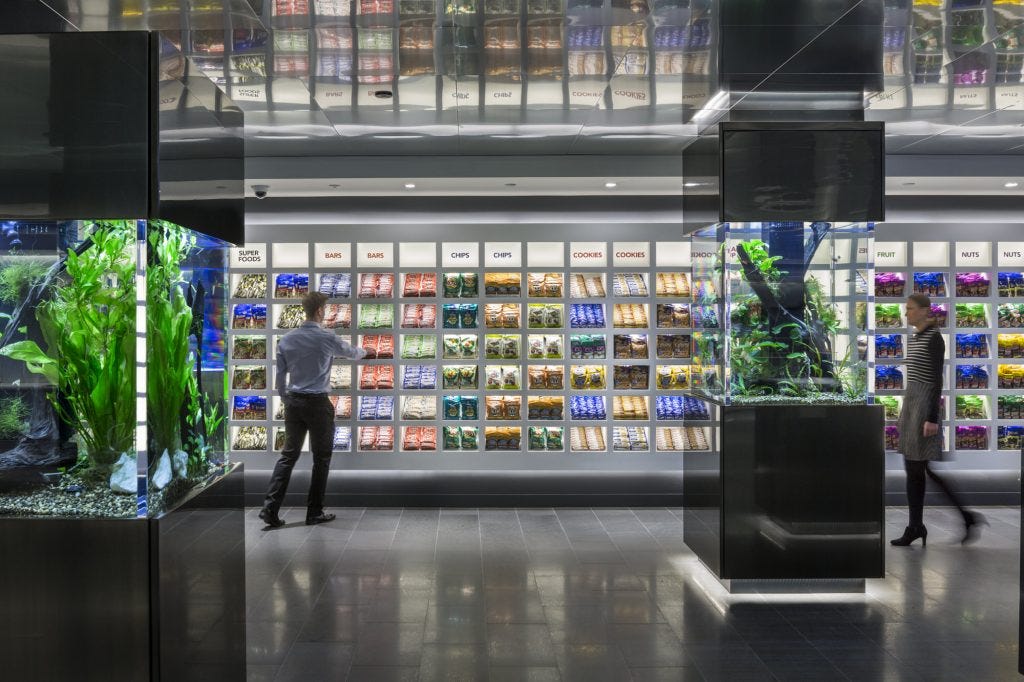
My initial "free food!" reaction quickly evolved as I learned that these pantries were hubs to mingle and exchange ideas. With focused discussions, technical terminology, and ideas flowing faster than coffee, striking up conversations felt daunting. One afternoon, I managed to approach a senior product manager. Surprisingly, he asked for my opinion on reorganizing the tech architecture. I wondered, What could an expert possibly gain from an intern? We traded ideas and algorithms, each building on the last. Surprisingly, as I reflected on these interactions, I realized that the open environment echoed an air of open-mindedness: everyone, regardless of position, came to learn and engage.
I spoke to friends who worked at other big tech companies in NYC. Meta NYC serves breakfast, lunch, and dinner and has a homemade ice cream bar, burger/fries bar, and a gaming room. Amazon NYC has an in-house barista who makes you your first drink of the day for free (think daily Strawberry Matcha Lattes), kombucha, and, of course, also has standard coffee stations. Google just built a gorgeous new campus in Hudson Yards. The amenities between each are similar (with some error), and there’s some variance in work-life intensity, but the cultures seem largely similar.
After spending two summers interning in big tech as a SWE (software engineer) intern at Bloomberg, I realized that my perspective on tech was quite limited. The amenities are enticing and pristine, the salaries are attractive, and occasionally, one might feel a sense of job security. Yet, working in big tech often makes you feel disconnected from reality. Working on a small team that has 5 sister teams, housed under a department, which is housed under a larger subsector, which reports to some other manager, and so on and so forth, can make your work feel intangible.
My first summer was on a regulatory reporting engineering team. The work was technically interesting, but the broader purpose didn’t have much appeal to me. I requested an ESG (Environmental, Social, Governance) team the following summer due to my passion for sustainability. The purpose was there, but the team was heavily involved in data and platform integration, which meant backend processes and not much connection with the external-facing product.
If you’re technically savvy, enjoy coding, and want a nice lifestyle, big tech is the place to be. I was speaking with my friend, who works at Meta and previously worked at several other large companies including Bloomberg and Jane Street, and she mentioned that this is the first time she’s actually been able to see her work in action (she’s on an Instagram team). I’m not saying that working in engineering for Big Tech implies that tangibility is impossible; it’s just less common. Even at Bloomberg, I could work on building tools for Wall Street professionals that are directly integrated into the Bloomberg Terminal UI if I chose to be on a specific team.
As someone with an inkling to apply tech directly to sustainability, I realized I needed to venture outside the corporate world and into startup culture to see what’s happening on the other side of the country in SF.
Start-Up Mania
Learning about all the latest news in the startup world has difficult uptake. The news changes on the daily. You’re expected to know what new marketing video Cluely just dropped. The unspoken rule is to join X (Twitter). Everyone knows everyone. Founders and Ivy League dropouts galore. Constant new startup ideas and product launches. Someone flexing their YC (Y-Combinator) status on LinkedIn. Lingo that doesn’t quite have any meaning anymore: “AI-Agentic B2B SaaS” — that’s really just fluff to say ChatGPT-wrapper. There’s no better time to fundraise than now.
The thing is, when you insert yourself headfirst into the start-up ecosystem, everything feels like pure energy, vision, and ambition. I made the mistake of initially believing that startups are intrinsically more valuable because everyone is dedicated to the cause and product. That all founders and employees are truly interested in building something beautiful and meaningful.
Many founders out there do have that passion. But the stark reality is that ~90% of startups fail. It’s an unfortunate truth that most builders know going into entrepreneurship. The disappointing result is that many builders just have a desire to build something. One startup fails, move on to the next idea until one finally works. Maybe you’ll be the next Mark Zuckerberg, Bill Gates, or Steve Jobs.
However, I see a lot of merit in startup culture that’s just completely different than corporate. Regardless of the motive, startups require you to do everything from the ground up. You only know Python? Not gonna cut it if you need your MVP built in 72 hours. The job description is actually 10 job descriptions. As a startup employee, you’re forced to wear many hats. One day you’re a product manager, one day you might be managing finances, one day you might be doing marketing.
For me personally, my fellowship at a small (~10 employees) yet well-established climate-impact investing startup required me to hop on several product and client calls, learn how to use solar design software, and understand the highly convoluted permitting process — in addition to doing the product automation work. I knew what I was getting myself into, but I was eager to take the leap and drink out of the firehose. Startups force you to learn skills you don’t have and grow quickly. And most importantly, with new startups, new reasoning models, and new frameworks constantly being released, you have to be on top of your game (or on top of Twitter) so you don’t fall behind with old technology.
One issue that I see with startups is that it’s occasionally difficult to know who you’re working with. When you have roles to fill and work to do, quickly, you’re almost vulnerable to hiring anyone whose resume will fit the role. That can mean hiring a vibe coder who doesn’t build a sustainable product that’ll last in the long term with new features (n.b., on vibe coding, I’ll just remark that you should at least have learned how to code yourself first).
As for the amenities, I can’t speak too much for in-person, SF-migrated startups, where employees live in hacker houses, but I have heard that there is more variance in terms of the degree of luxury. Some companies can match Big Tech snacks and offices in a smaller setting, while others use WeWork-type spaces and just have coffee. The startup I worked at chose to have employees from across the globe with no relocation required, so we used a virtual office using Kumospace (don’t worry, we got to decorate our offices, and at least I could say I had my own!).
Women in Tech
Let’s have the uncomfortable conversation.
I had the opportunity to attend New York Tech Week earlier this summer, and while exciting with the frenzy of events and socials, female founders were a rare sighting. They were there, but far outnumbered by the tech-bros showcasing their latest product. In my opinion, female founders are less common for multiple reasons, but one that stands out is risk-aversion. In my female companions and colleagues, I have witnessed a tendency for women not to necessarily take that leap if their detailed analysis can’t guarantee positive results. On the other hand, I have seen guys be more willing to act on their drive and ideas, even in riskier scenarios. This is a generalization, and I acknowledge that there are exceptions to every rule. Nonetheless, both qualities, thoughtful consideration and actionable ambition, are admirable. But startups need a balance of both traits to thrive. With a deeply-rooted tech-bro culture, women are already resistant to entering these sectors, and the uncertainty does not make that any more welcoming.
On the opposite end, corporate culture is not much better. It’s getting better, but there is still a long way to go. When I applied for my Bloomberg internship, I was acutely aware, per NCWIT (National Center for Women in IT), that women comprised only 13% of engineers. As I walked around the floors and past the engineering teams, 90% were men, and I saw the statistics come alive. On my first team, I was lucky enough to have a female TL (team lead) and a female mentor. On my second team, I had a female mentor and a female colleague. But using the baseline of ~10 for the average size of a team, mine were still only at 20%. A fellow intern had a not-as-favorable experience and mentioned that she sensed the prejudice heavily and felt unheard and underestimated.
The question that I still revisit is: if we women have the drive and ambition and enjoy the work to build a career in tech, how do we insert ourselves and tolerate a culture that wasn’t built for us?
I’m not trying to make commentary on diversity hires, but simply point out the culture that’s prohibiting women from breaking into both realms of tech.
Bubbles of Opposing Worlds
The moment I was introduced into the startup world, I immediately resorted to believe that I had been working in the wrong place all along (big tech). But the more I thought about it, I realized that it’s a privilege to be able to call yourself a founder or work at a startup. The security is virtually none, and while the pay might be good if you are working at a well-funded startup, you have to be ready for things to end overnight and have enough financial fallback.
Part of the allure of big tech is the financial security of the contracted 6-figure salaries with benefits — not having to worry (as much). Google’s unlikely to shut down overnight. I used to judge people who wanted to be sellouts at FAANG (or MANGO) simply because of the glistening paychecks. But working at a startup is not necessarily a liberty that everyone can afford to take, and that’s not discussed enough.
Interestingly, exploring startup culture has truly helped me see the bubbles that enclose SF and NYC. The vast majority of startup culture lives in SF, the Bay Area, and Silicon Valley. The things that seem trivial to people entrenched in that culture are not common knowledge outside. The basic expectation in normal society is still at a ChatGPT level. In New York, people are heavily entrenched in a culture of networking and corporate jobs. Finance, fin-tech, and consulting live in New York at an extreme unmatched anywhere else in the U.S. Yet, sellout culture lives on college campuses and in big cities.
The hustle is there on both coasts; it just manifests itself so differently through their own echo chambers. SF worships innovation and the next unicorn; NYC reveres prestige and polished career ladders. Neither is objectively better, but both can make you feel like you’re failing if you don’t conform. At schools like Stanford or UC Berkeley, or even California high schools, it’s so easy to feel like you’re not doing the right things if you’re not pursuing tech or entrepreneurship. At schools like Wharton and Harvard, the consulting and finance vortex is so strong that ~40% end up pursuing those jobs for entry-level positions, many of whom just chose that career path because they were uncertain of their dream job. When everyone around you is saying one thing and you’re doing another, it feels impossible not to feel like an imposter and avoid the rat race. The bubbles are real, and every once in a while, it’s nice to maintain perspective.
For anyone who has worked in both or either sector, would love to hear your thoughts! As with everything, there are pros and cons.
Until next time,
—Radha